From supplier to customer, one loop with no gaps.
Most sellers buy in one tool, count in a spreadsheet and sell in another, and pay for every gap between them in oversold orders, stockouts and double POs. Makeships runs the whole loop as one system: every delivery, sale and shipment updates the next step on its own. In your own cloud, with no cut of your sales.
- 0% of your sales
- Runs in your own cloud
- AI on your own keys
- One sign-in across apps
- 1 Supplier
- 2 Purchase request
- 3 Purchase order
- 4 Goods receipt
- 5 Stock in
- 6 Online store
- 7 Customer order
- 8 Pick · pack · ship
- 9 Stock updated
- ↻ Low stock starts the next purchase request.
Your tools each work. The handoffs between them don't.
A store platform, a stock sheet and a purchasing inbox can each be fine on their own. The money leaks where one hands off to the next and a person has to carry the numbers across.
- 1 Gap
Supplier → purchase order
POs go out over WhatsApp and email. The store flags low stock, the warehouse raises a PO too, and the supplier ships double.
- 2 Gap
Delivery → stock count
Goods are counted on paper and keyed in days later, so the store keeps selling on last week's numbers.
- 3 Gap
Stock → storefront
Two shoppers pay for the last unit during a sale, and someone has to call one of them to cancel.
- 4 Gap
Shipping → stock
Nobody can say what's on the shelf versus what's already promised, so the count drifts until the next stocktake.
Nine steps, three apps, zero re-typing.
Follow one item from the supplier to the customer's door and back to the next order. At every step, the green arrow marks what moves on to the next without anyone typing it. Your team only steps in where a decision needs a person.
AI agent works in the background under your policy and asks a person where money or stock moves. AI assistant is one you or your customers talk to. On your own AI keys.
Buy
Makeships Procurement
Suppliers, requests, approvals and purchase orders under your rules.
- 1
Supplier
AI agentVendors, contacts, contracts and performance in one place. Run RFQs, compare quotes, or order from a supplier's PunchOut catalogue.
- Agent Drafts the outreach email to each vendor you invite to an RFQ, for you to review and send.
Preferred supplier and agreed prices are ready when stock runs low.
- 2
Purchase request
AI assistant AI agentLow stock raises one request on its own, for the reorder quantity. Approval rules by amount and budget decide who signs off.
- Assistant Describe what you need in plain words and it drafts the request, lines and all.
- Agent Approves requests your policy allows, and tells the approver why when it can't.
The same item isn't requested twice, whichever team noticed first.
- 3
Purchase order
An approved request becomes a PO in one click, with the supplier and prices already on it.
PunchOut suppliers receive the PO directly, and it syncs to your accounting system without re-typing.
- 4
Goods receipt
AI agentReceive what arrived against the PO, line by line. Approve the supplier invoice after matching it to the PO and the delivery.
- Agent Matches each invoice against the PO and what arrived; a person still approves payment.
- Agent Flags a vendor whose spend jumps against its recent months.
Received goods are added to stock, and the invoice sets each item's real cost.
Stock
Makeships Inventory
One count of what you have, where it is and what it cost.
- 5
Stock in
AI assistant AI agentEvery warehouse, every movement, with transfers, adjustments and cycle counts. Costs follow what you actually paid.
- Assistant Type "received 50 blue tees at Chennai" and it prepares the stock movement for you to approve.
- Agent Flags cycle counts that don't add up, and stock that has stopped selling.
The store shows the new stock within seconds, so it's back on sale straight away.
Sell
Makeships Commerce
Your storefront, checkout, payments and delivery, with no cut of your sales.
- 6
Online store
AI assistant AI agentStorefront, catalogue, coupons, reviews and GST built in. What shoppers see is what the warehouse has available.
- Assistant A shopping assistant finds, compares and adds products to the cart for your customers.
- Agent Publishes genuine reviews, negative ones included, and holds back spam.
Available stock comes straight from Inventory: nobody updates it by hand.
- 7
Customer order
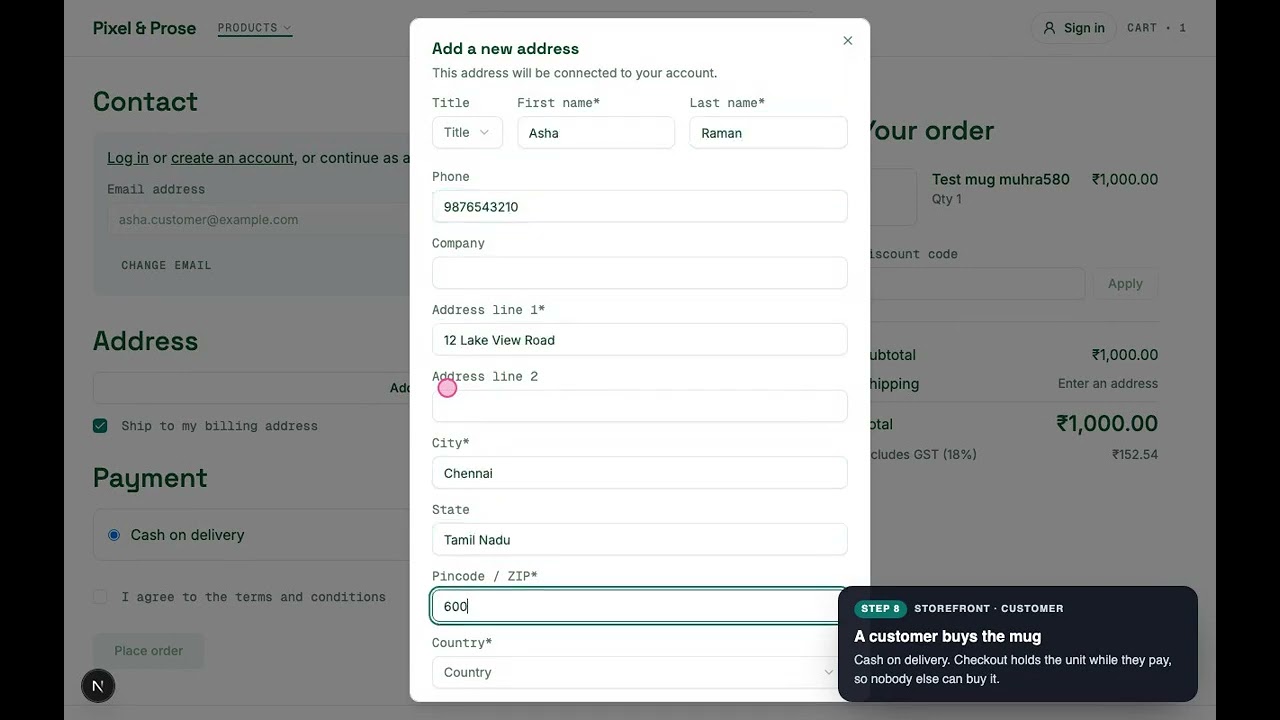
AI assistant AI agentRazorpay, Stripe or cash on delivery, with pincode checks. Checkout holds the units while the customer pays.
- Assistant Customers ask where their order is and get the answer from the order itself.
- Agent Reminds signed-in customers about a cart they left, with the discount your policy allows.
Held stock is off sale everywhere at once, so the last unit is sold only once.
- 8
Pick · pack · ship
The order stays held until it's packed and shipped. Book Shiprocket or Delhivery automatically and track delivery.
Shipping the order is what takes the stock off the shelf.
Close the loop
Makeships Inventory
Stock changes the moment goods move, and low stock starts the next purchase.
- 9
Stock updated
AI agentShipped orders leave the count; cancellations release their hold; returns come back in once they're received.
- Agent Tunes reorder points from how fast each item sells, and asks for a restock before a best-seller runs out.
Below the reorder point, a purchase request goes to Procurement, and the loop starts again at step 2.
And round again: the next purchase request is already waiting for approval before you notice the shelf is low.
See all nine business loops, and what the agents handle →The same week, run as one system.
- The last unit in a sale With separate tools: Sold twice; one customer gets a refund and an apology With Makeships: Held at checkout, so the second shopper sees it's sold out before paying
- Restocking With separate tools: Two people raise POs for the same item With Makeships: One request per item, approved by amount, turned into one PO
- A delivery arrives With separate tools: Counted on paper, typed in later With Makeships: Received against the PO; store and warehouse update at once
- Stock you've promised With separate tools: Mixed in with stock on the shelf With Makeships: Held for its order until it ships, and never sold twice
- What an item really costs With separate tools: Last year's price in a spreadsheet With Makeships: Set from the supplier invoices you approve
- Who changed what With separate tools: Scrolled out of a WhatsApp group With Makeships: In an audit log across all three apps
Close the loop one app at a time.
You don't have to switch everything in a weekend. Each app is a complete product on its own, and each one you connect closes another gap. Your business keeps running the whole time.
- 01 Start where it hurts Makeships Commerce Most sellers start with the store: flat pricing, no cut of sales, checkout and shipping built in. Others start with Inventory or Procurement. Each app runs on its own, with its own database.
- 02 Connect the next app Makeships Inventory Paste an API key in settings and the apps connect. The store starts holding stock at checkout and reading real availability. No migration project, no downtime.
- 03 Close the loop Makeships Procurement Add Procurement and low stock becomes purchase requests, deliveries become stock, and invoices become costs. Your team approves; the handoffs run themselves.
One platform you own, not three subscriptions you rent.
One sign-in across the apps, one audit log, and the same way of running underneath, so the second app is quicker to adopt than the first.
Your cloud, your data
Every app runs in your AWS, GCP or Azure account, or on your own servers. We ship updates; we never hold a copy of your data.
AI on your keys, with approvals
Model calls go straight to your provider with no markup. Where money or stock moves, an agent drafts the change and a person approves it.
Built not to double-count
Every handoff carries a reference the receiving app remembers, so a retry or an outage never counts a sale or a delivery twice.
Open to your own tools
The apps talk over a documented, signed API. Use the same API, webhooks and MCP servers to connect your own tools and agents.
Picmychip: a store built around how its buyers order.
An Indian online store for 320+ datasheet-verified electronics components, selling to engineers, makers and B2B buyers. It runs on Makeships Commerce.
- Branding and a store rebuilt on Makeships Commerce
- Instant Sourcing Hub: upload a BOM, get stock and pricing line by line
- Live chat for buyers partway through an order
- A Guides and Tutorials hub for trust and search
B2B buyers work from a bill of materials, not one part at a time. So the store takes the whole BOM and matches every line against live stock and pricing.
Everything that helps a store sell more, without a cut of your sales.
Commerce, Inventory and Procurement as one connected system, on one plan. Priority support for the whole system.
Talk to us: priced for your stores, warehouses and team.
Founding stores: 50% off the first year
The first five brands to launch on Makeships Commerce get half off the Launch package and their first year of Growth, in return for a case study.
Do I have to buy the whole suite?
No. Every Makeships app runs on its own with its own database. Most teams start with one and connect the others later from settings, when the next handoff starts to hurt.
When does stock actually leave the count?
When the order ships. Checkout holds the units while the customer pays, and the hold stays in place while the order is picked and packed, so promised stock can't be sold again. Shipping takes it off hand; cancelling before then puts it straight back on sale.
What happens at checkout if the warehouse app is down?
Checkout carries on without holding stock, so you never lose a sale to an outage. Everything catches up once it's back, and nothing is counted twice.
Can you move my store from Shopify or WooCommerce?
Yes. The Launch package (₹75,000, one-time) moves up to 500 products and your customers, and sets up payments, shipping, GST and email.
What does bring your own cloud mean?
The apps run in infrastructure you own: an AWS, GCP or Azure account, or your own servers. Your data, files and AI calls stay there. Managed hosting is available if you'd rather we run it.
Do you take a percentage of my sales?
No, on any plan. Your payment gateway's fees are the only per-order cost.
How is it priced?
Commerce is free on the Community plan and ₹49,999 per store, per year on Growth. The Operations Suite, our premium plan, connects Commerce, Inventory and Procurement and is quoted for your stores, warehouses and team.
See your own loop, from supplier to customer, in one system.
Tell us how you buy, stock and sell today. We'll map where your handoffs leak, show the apps that close them, and what they cost to run.